

The Consultancies Aren’t Coming for Your Clients. They Already Have Them.
While the holding companies have been busy building AI platforms and issuing press releases about transformation, Accenture, McKinsey and Deloitte have been quietly repositioning.

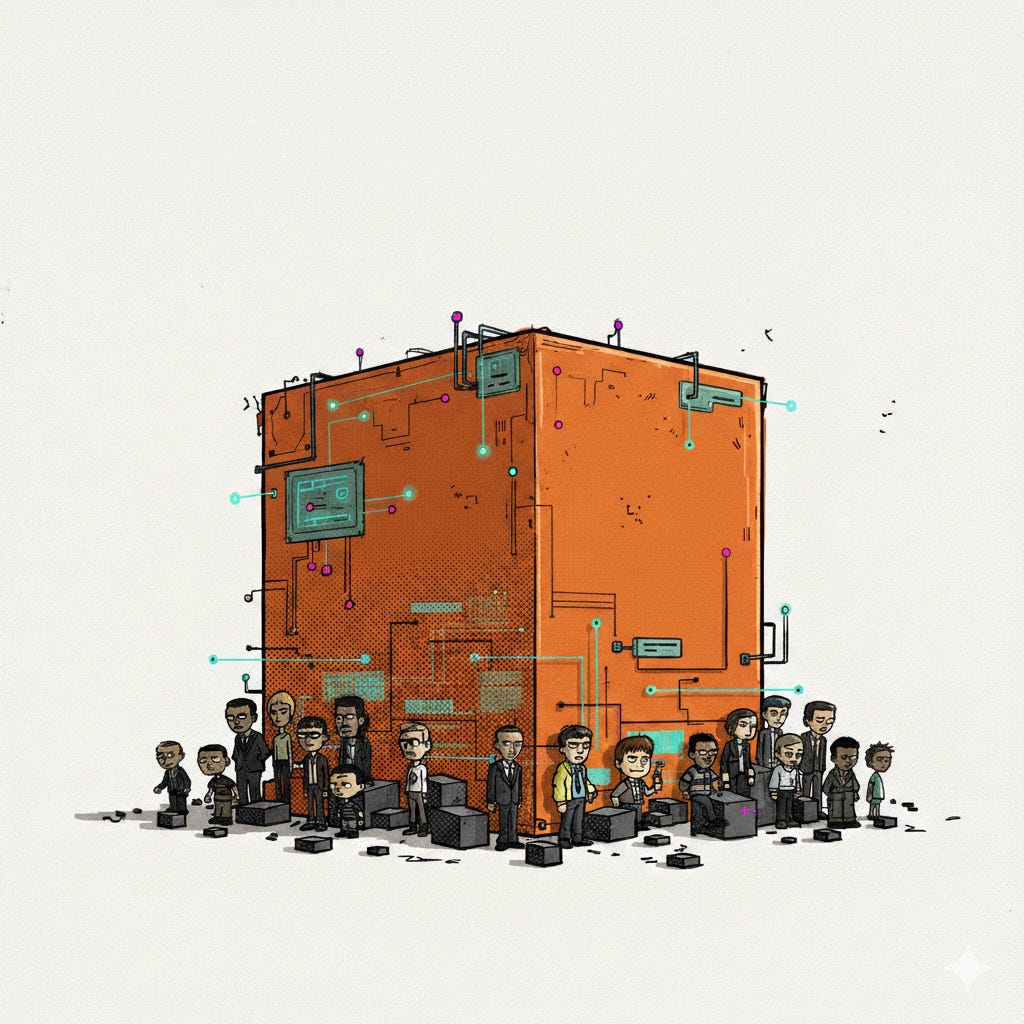
The $20 Billion Agency You’re Not Watching
Let’s start with a number that should stop every holdco strategist in their tracks. Accenture Song generated $20 billion in revenue in fiscal year 2025. That’s up 8% year on year. For context, WPP reported £14.7 billion in 2024. Publicis made €16.03 billion. The world’s largest agency, by revenue, is not an agency at all. It’s a division of a consulting firm.
And it’s not just the scale that matters. It’s where Song sits in the food chain. Earlier this year, Accenture folded Song into its new Reinvention Services unit alongside strategy, consulting and technology. That’s not a reorganisation for neatness. It’s a statement of intent. Song no longer operates as a creative agency that happens to be owned by a consultancy. It operates as the customer-facing layer of a full-stack transformation business.
As Digiday reported in January, Song has moved upstream of advertising entirely. It designs data architecture, integrates platforms, reshapes workflows and retrains the teams that operate within AI-led systems. One recent engagement with a CPG manufacturer involved scaling a generative AI platform to cut content production costs by 30 to 50%, then extending the work into retraining marketing teams, restructuring workflows and redesigning decision systems. That’s not an agency brief. That’s an operating model engagement that happens to include marketing; and therefore right up my street.
This is the crucial distinction. The holdcos are trying to sell AI as a better way to do agency work. Accenture is selling AI as a reason to rethink whether you need the agency at all.
And here’s what makes this particularly pointed: WPP tried to build exactly what Song has become. I know, because I was part of it. I worked in Acceleration, a data and technology consultancy inside WPP that was originally acquired by Mark Read himself when we were part of Wunderman. On paper, we did what Song does: data architecture, platform integration, transformation consulting. But in my opinion, WPP never quite knew what to do with us. We got moved into GroupM, refocused on Google Cloud tools with a media buying slant, and the holistic transformation consulting vision gradually narrowed into something the holdco model could understand: a support function for media often seen as a freebie to give away rather than understanding the true value of consulting
I was made redundant in 2024 before the team migrated into Choreograph. My experience is obviously just one perspective. But it illustrates something structural. WPP could see the opportunity that Song is now capitalising on. It acquired the capability. It had the people. What it couldn’t do was let a consulting-led, transformation-first business operate on its own terms within a structure built around agency services and media revenue. The gravitational pull of the holdco model kept dragging it back toward what WPP already knew how to sell.
Accenture doesn’t have that problem. Song sits inside a consulting firm, not an agency network. Its natural orbit is enterprise transformation, not media plans. The same capability that WPP couldn’t quite nurture is thriving inside a structure that was built for it. That’s not a criticism of any individual decision. It’s a structural observation about what different business models are capable of sustaining.
McKinsey’s Quiet Land Grab
McKinsey doesn’t run a creative agency. It doesn’t buy media. It doesn’t produce campaigns. And that’s precisely what makes its move into marketing services so dangerous for the holdcos.
McKinsey’s Growth, Marketing and Sales practice has spent the last two years positioning agentic AI as the future of how marketing actually operates inside large organisations. Their research estimates that agentic AI will power more than 60% of the increased value that AI generates in marketing and sales. They’re publishing case studies showing Fortune 250 brands achieving campaign execution speeds 15 times faster and customer satisfaction improvements measured in hundreds of percentage points.
But the real threat isn’t the research. It’s the access. McKinsey is already in the room with the CEO, the CFO and the board. When they present a framework for restructuring marketing operations around AI, the recommendation doesn’t land on an agency review list. It lands on the enterprise transformation agenda, where budgets are measured in tens of millions and the agency relationship becomes a line item to be rationalised rather than a partnership to be deepened.
Their recent martech research revealed something that should alarm every agency leader: not one of the 50-plus senior marketing officers McKinsey interviewed at Fortune 500 companies could quantify the ROI of their marketing technology investments. That’s an open invitation for a consultancy to walk in, audit the stack, redesign the operating model and, in the process, determine which agency relationships survive and which don’t.
McKinsey doesn’t need to win agency pitches. It just needs to be in the room when the client decides whether agencies are still necessary.
Deloitte Digital: The Quiet Builder
Deloitte Digital occupies a different position again. Revenue grew 10% to $753 million in 2024, which makes it significantly smaller than Song but still substantial. What makes Deloitte interesting is the depth of its platform relationships. It holds top-tier partnerships with Salesforce, Adobe and AWS, and scored highest across all five use cases in Gartner’s 2025 assessment of digital experience services.
Where Accenture has moved upstream and McKinsey operates at the strategic layer, Deloitte has embedded itself at the infrastructure level. Its Converge platform, Creativ-Edge AI content solution and Content Intelligence Hub aren’t competing with agencies for creative briefs. They’re competing for the plumbing underneath, the martech stack, the data layer, the automation framework that increasingly determines what agencies can and can’t do.
This is the consultancy play that’s hardest for agencies to see, let alone counter. By the time a holdco learns that Deloitte has redesigned a client’s content supply chain or implemented an AI-driven personalisation engine, the agency’s role has already been redefined. Not eliminated, necessarily, but contained. The agency becomes a supplier of creative assets plugged into a system it didn’t design and doesn’t control.
Three Different Approaches, One Common Strategy
The consultancies aren’t running the same play. Accenture is building a parallel agency at scale. McKinsey is reshaping how CMOs think about marketing operations. Deloitte is rewiring the technology layer. But all three share something the holdcos don’t have: a relationship with the client that begins at the enterprise level and works down to marketing, rather than beginning at marketing and trying to work up.
This is the structural advantage that no amount of AI investment can overcome. When a CEO asks McKinsey to redesign how the organisation uses AI, marketing is one chapter in a broader transformation. When an agency tells that same CEO it has an AI platform, it’s a vendor pitching a tool.
The holdcos know this, of course. WPP hired a Microsoft executive as CEO. Publicis has invested billions in data and technology. Omnicom merged with IPG partly to create a data asset that could compete at the enterprise level. But knowing the problem and solving it are different things. The consultancies have spent decades building trust at board level. Agencies have spent decades building trust with CMOs. In an era where AI decisions are being made by the C-suite and the board, the consultancies start with a structural advantage that’s very difficult to replicate.
The Squeeze
If you’re a holdco CEO reading this, the picture emerging across these three articles isn’t comfortable. Your AI strategy, however well-funded, hasn’t convinced investors. Your competitors in the holdco space are all making different bets with no clear winner. And the consultancies are quietly taking the conversation upstream to the people who sign off on whether your services are even required.
This is what a squeeze looks like. Pressure from above, as consultancies capture strategic influence and operating model decisions. Pressure from below, as AI tools commoditise the execution work that has historically been the agency’s bread and butter. And pressure from the market, which has decided that the entire services sector is vulnerable to disruption.
But is this actually a new dynamic? Or is it the same pattern playing out for the third time in thirty years of “digital”?
Howard Scott has spent thirty years in the agency industry and writes about transformation, technology and the future of marketing services. Connect on LinkedIn or subscribe to this newsletter.